

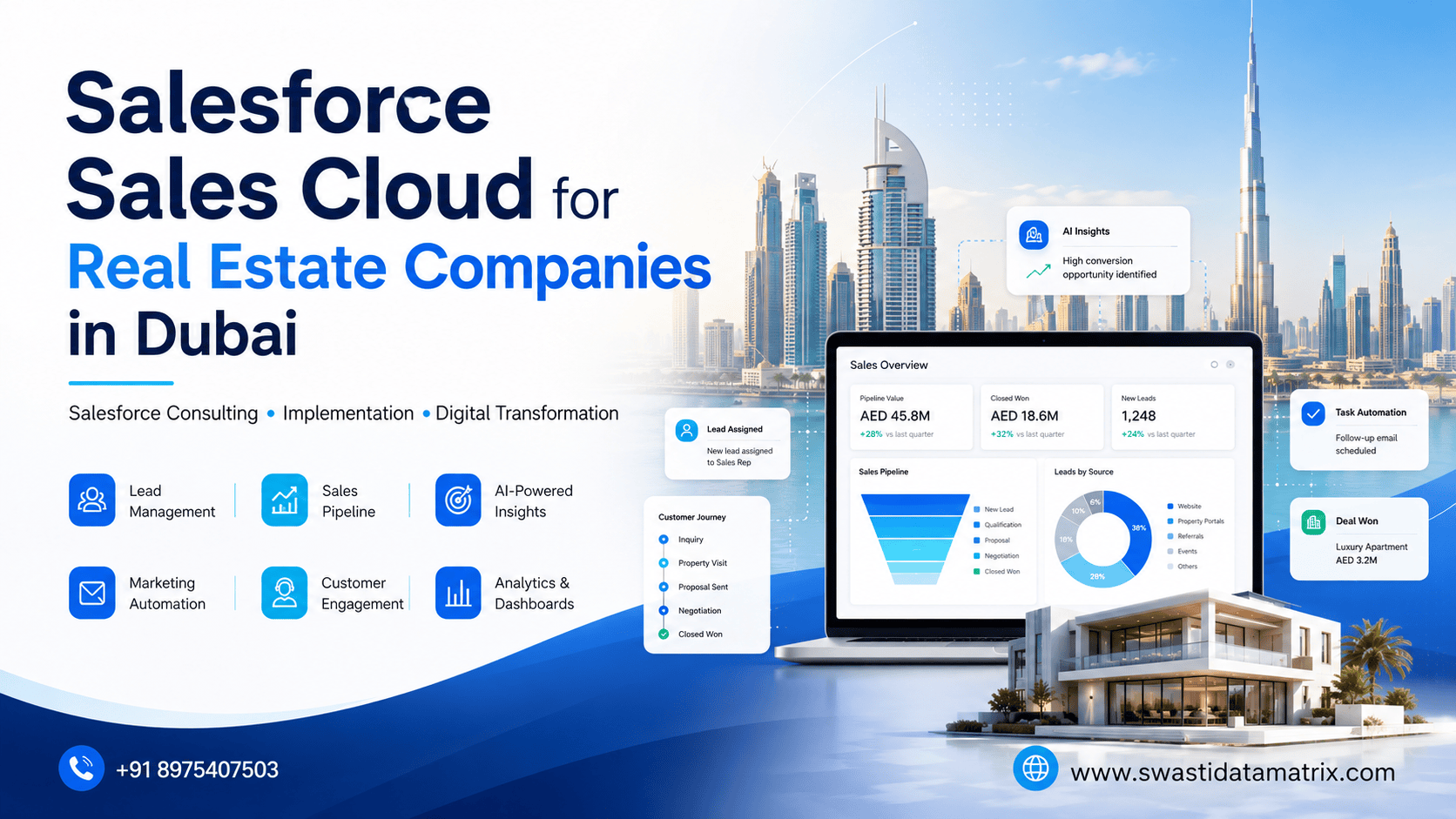
Salesforce Sales Cloud for Real Estate Companies in Dubai
Introduction
Dubai's real estate market is one of the world's most competitive and dynamic property sectors. From luxury residential developments and commercial spaces to off-plan investments, real estate companies manage thousands of inquiries from investors, homebuyers, tenants, and brokers every month.
However, managing these leads across spreadsheets, WhatsApp, phone calls, emails, property portals, and multiple sales teams often results in missed opportunities and slower response times.
This is where Salesforce Sales Cloud for Real Estate Companies in Dubai becomes a game changer. It enables developers, brokers, and real estate agencies to centralize customer data, automate sales processes, improve lead conversion, and deliver personalized client experiences across every touchpoint.
Whether your business operates in Dubai, Abu Dhabi, across the UAE, or expands into Saudi Arabia, Salesforce helps create a scalable, AI-powered CRM ecosystem that supports long-term growth and digital transformation.
Why Real Estate Companies Need Salesforce Sales Cloud
Real estate transactions involve multiple stakeholders, long sales cycles, extensive documentation, and continuous communication.
A modern CRM helps organizations:
-
Capture leads automatically from websites and property portals
-
Track every buyer journey
-
Assign leads intelligently
-
Improve broker productivity
-
Forecast sales pipelines accurately
-
Automate follow-ups
-
Provide management with real-time dashboards
-
Enhance customer experiences across channels
For businesses serving multilingual customers across the Middle East, Salesforce also supports multilingual communication, omnichannel engagement, and scalable workflows that align with regional digital transformation initiatives.
Common Business Challenges
Many real estate firms experience challenges such as:
| Challenge | Business Impact |
|---|---|
| Lost website leads | Reduced revenue |
| Slow response time | Lower lead conversion |
| Manual follow-ups | Poor customer experience |
| Scattered customer data | Inconsistent communication |
| Limited sales visibility | Difficult forecasting |
| Broker performance tracking | Lack of accountability |
| Multiple communication channels | Operational inefficiencies |
| Manual reporting | Delayed business decisions |
How Salesforce Sales Cloud Solves These Challenges
Salesforce Sales Cloud centralizes customer interactions into a single platform.
Key capabilities include:
-
Automated lead capture from websites and property portals
-
Lead scoring and qualification
-
AI-powered opportunity management
-
Property-specific sales pipelines
-
Automated reminders and workflows
-
Mobile CRM for agents
-
Email and calendar integration
-
Document management
-
Quote generation
-
Performance dashboards
-
Sales forecasting
-
Role-based security and compliance support
With AI-powered insights, sales managers can identify high-value opportunities while brokers spend more time building relationships instead of managing spreadsheets.
Salesforce Products Relevant for Real Estate
Sales Cloud
The foundation for managing leads, opportunities, customer interactions, broker activities, and sales forecasting.
Service Cloud
Helps customer support teams handle inquiries, service requests, and post-sale communication efficiently.
Marketing Cloud
Useful for nurturing property buyers through email campaigns, SMS, WhatsApp journeys, and personalized marketing. Businesses looking to enhance customer engagement can also benefit from Salesforce Marketing Cloud Services UAE offered by Swasti Data Matrix.
Experience Cloud
Enables secure customer and broker portals where clients can track property status, submit documents, and communicate with sales representatives.
Data Cloud
Creates a unified customer profile by combining information from websites, CRM, marketing platforms, and third-party systems, enabling more personalized engagement.
Agentforce
AI-powered digital agents assist sales teams by summarizing customer conversations, recommending next best actions, and automating repetitive tasks.
CRM Analytics
Provides executives with interactive dashboards, sales trends, revenue forecasting, and broker performance insights.
Benefits of Salesforce Sales Cloud
| Benefit | Business Value |
|---|---|
| Faster lead response | Higher conversion rates |
| Centralized CRM | Single source of truth |
| Automated workflows | Reduced manual effort |
| AI insights | Smarter sales decisions |
| Mobile accessibility | Productivity anywhere |
| Sales forecasting | Better planning |
| Customer history | Personalized interactions |
| Scalable platform | Supports business growth |
Implementation Process
A successful Salesforce implementation typically includes:
-
Business discovery and requirement gathering
-
CRM strategy and process mapping
-
Salesforce configuration
-
Data migration
-
Third-party integrations
-
Automation setup
-
User acceptance testing
-
Employee training
-
Go-live
-
Continuous optimization
Organizations working with an experienced Salesforce Implementation Partner Dubai can accelerate deployment while reducing project risks.
Industry Use Cases
Salesforce Sales Cloud is valuable for:
-
Property developers
-
Real estate agencies
-
Commercial real estate firms
-
Luxury property consultants
-
Property management companies
-
Mortgage consultants
-
Investment advisory firms
Comparison Table
| Traditional CRM | Salesforce Sales Cloud |
|---|---|
| Manual updates | Automated workflows |
| Limited reporting | Real-time analytics |
| Disconnected systems | Unified platform |
| Spreadsheet tracking | Centralized CRM |
| Reactive sales | AI-assisted selling |
| Limited scalability | Enterprise-ready platform |
Pricing / Cost
Salesforce pricing depends on:
-
Number of users
-
Salesforce edition
-
Required integrations
-
Customization needs
-
AI capabilities
-
Industry-specific workflows
In addition to licensing costs, businesses should budget for implementation, customization, user training, integrations, and ongoing managed services.
Partnering with experienced consultants helps optimize total cost of ownership and ensures the platform aligns with business objectives.
Implementation Timeline
| Project Size | Estimated Timeline |
|---|---|
| Small agency | 4–6 weeks |
| Mid-sized company | 8–12 weeks |
| Enterprise developer | 3–6 months |
Actual timelines vary depending on complexity, data quality, integrations, and customization requirements.
Latest Salesforce Trends for 2026
Real estate organizations are increasingly adopting:
-
AI-powered CRM with Agentforce
-
Predictive lead scoring
-
Hyper-personalized customer journeys
-
First-party customer data strategies
-
Data Cloud for unified customer profiles
-
Omnichannel engagement across email, WhatsApp, and social media
-
Low-code automation for faster process improvements
-
AI-assisted forecasting and reporting
-
Marketing automation for buyer nurturing
-
Intelligent workflow automation to reduce manual tasks
These trends help organizations respond faster to customer expectations while improving operational efficiency.
Best Practices
-
Define clear sales processes before implementation.
-
Standardize lead qualification criteria.
-
Automate repetitive tasks.
-
Train brokers regularly.
-
Keep customer data clean and accurate.
-
Monitor KPIs through dashboards.
-
Integrate marketing and sales activities.
-
Continuously optimize workflows based on business insights.
Common Mistakes to Avoid
-
Migrating poor-quality data
-
Over-customizing the CRM
-
Ignoring user training
-
Skipping change management
-
Not defining measurable KPIs
-
Delaying integrations
-
Focusing only on technology instead of business processes
Salesforce Implementation Checklist
| Checklist | Status |
|---|---|
| Business goals defined | Checked |
| Sales processes documented | Checked |
| Data cleansing completed | Checked |
| User roles identified | Checked |
| Integrations planned | Checked |
| Automation configured | Checked |
| Security reviewed | Checked |
| Training completed | Checked |
| Testing finished | Checked |
| Go-live support arranged | Checked |
Case Study
Industry
Real Estate Development
Challenge
The company struggled with fragmented lead management across property portals, delayed follow-ups, and limited visibility into broker performance.
Solution
Implemented Salesforce Sales Cloud with automated lead routing, opportunity tracking, CRM Analytics dashboards, and Marketing Cloud integration for lead nurturing.
Salesforce Products Used
-
Sales Cloud
-
Marketing Cloud
-
CRM Analytics
-
Data Cloud
Implementation
A phased deployment integrated website forms, property portals, email systems, and mobile access for brokers.
Results
-
34% increase in lead conversion
-
41?ster response time
-
29% improvement in customer engagement
-
28% reduction in manual administrative work
These outcomes are illustrative and can vary depending on implementation quality, business processes, and user adoption.
ROI
Improved sales productivity, better forecasting accuracy, and a more consistent customer experience across the sales lifecycle.
Lessons Learned
Success depended on clean data, user training, executive sponsorship, and continuous process optimization.
Frequently Asked Questions
1. What is Salesforce Sales Cloud?
A CRM platform that helps businesses manage leads, opportunities, customer relationships, and sales processes.
2. Why is it important for real estate companies?
It centralizes customer information, automates sales workflows, and improves lead conversion.
3. How does Salesforce Sales Cloud work?
It captures leads, tracks interactions, automates follow-ups, and provides AI-powered insights for sales teams.
4. Who should use Salesforce Sales Cloud?
Real estate developers, agencies, brokers, property management firms, and commercial real estate businesses.
5. What are the benefits?
Improved productivity, faster response times, better forecasting, enhanced customer experiences, and scalable growth.
6. How much does Salesforce Sales Cloud cost?
Costs vary based on licensing, user count, implementation scope, customization, and integrations.
7. How long does implementation take?
Typically between 4 weeks and 6 months, depending on project complexity.
8. What mistakes should businesses avoid?
Poor data quality, lack of user training, excessive customization, and unclear business objectives.
9. Why choose a Salesforce Partner?
Experienced partners reduce implementation risks, accelerate deployment, and tailor the platform to business needs.
10. Can Salesforce integrate with property portals?
Yes. Salesforce supports integration with websites, property portals, ERP systems, and third-party applications.
11. Is Salesforce suitable for companies operating across the UAE and Saudi Arabia?
Yes. Salesforce supports multi-region operations, multilingual users, compliance requirements, and scalable business growth.
12. Does Salesforce support mobile sales teams?
Yes. Brokers and sales representatives can securely access CRM data through mobile applications.
Conclusion
For real estate companies in Dubai, adopting Salesforce Sales Cloud is more than a technology upgrade—it's a strategic investment in customer experience, operational efficiency, and long-term growth. By centralizing customer data, automating sales workflows, and leveraging AI-driven insights, businesses can respond faster to inquiries, improve lead conversion, and make more informed decisions.
To maximize these benefits, partnering with an experienced Salesforce consulting firm is essential.
Ready to Transform Your Real Estate Sales?
At Swasti Data Matrix, we help organizations across the UAE and Saudi Arabia unlock the full potential of Salesforce through consulting, implementation, customization, integration, migration, Marketing Cloud solutions, and managed services.
Our expertise includes:
Whether you're modernizing an existing CRM or implementing Salesforce for the first time, our experts can guide you every step of the way.
Website: https://www.swastidatamatrix.com
Phone: +91 8975407503
Book a Free Consultation today and discover how Salesforce can help your real estate business grow smarter and faster.