

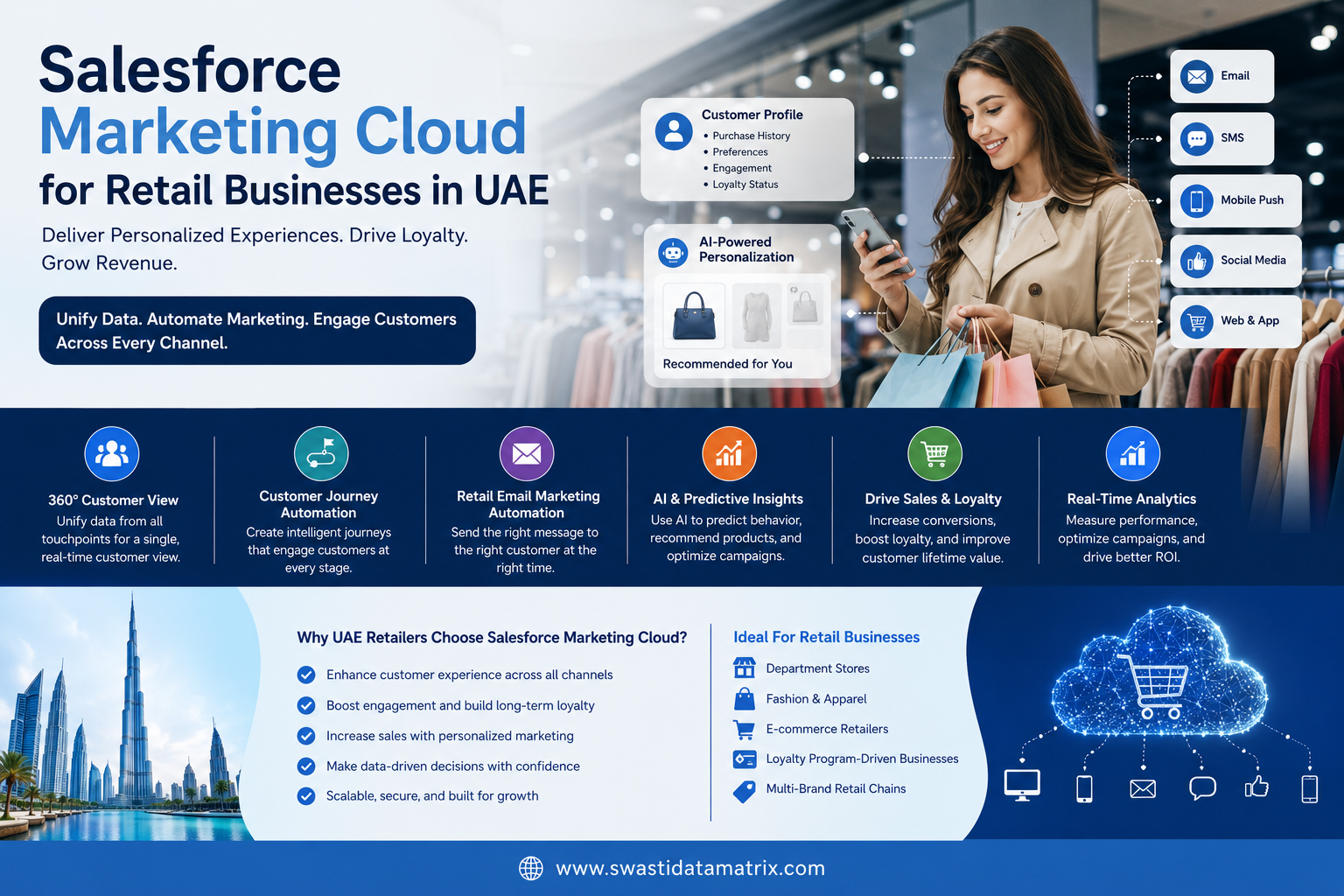
Salesforce Marketing Cloud for Retail Businesses in UAE
Introduction
The retail industry in the UAE is undergoing a significant digital transformation. Consumers today expect personalized experiences, seamless omnichannel interactions, real-time engagement, and highly relevant marketing communications. Traditional marketing methods are no longer sufficient to attract, engage, and retain customers in an increasingly competitive marketplace.
This is where Salesforce Marketing Cloud for Retail Businesses becomes a strategic advantage.
As retailers across Dubai, Abu Dhabi, Sharjah, and other Emirates strive to improve customer experiences and increase revenue, Salesforce Marketing Cloud provides a comprehensive platform for customer engagement, marketing automation, data-driven decision-making, and personalized customer journeys.
Modern retailers face several challenges:
-
Increasing customer acquisition costs
-
Fragmented customer data
-
Low customer retention rates
-
Limited visibility across channels
-
Inefficient campaign management
-
Rising customer expectations
Salesforce Marketing Cloud addresses these challenges by enabling businesses to deliver personalized experiences across email, mobile, social media, websites, advertising channels, and customer service touchpoints.
Organizations seeking specialized implementation support often work with experienced Salesforce consultants and implementation partners. Businesses looking for Salesforce Marketing Cloud UAE solutions can explore professional implementation and consulting services through Swasti Datamatrix's Salesforce Marketing Cloud expertise:
https://www.swastidatamatrix.com/services/salesforce-marketing-cloud-uae.html
This article explores how Salesforce Marketing Cloud is transforming retail businesses in the UAE, key capabilities, implementation considerations, pricing factors, industry applications, and future trends shaping retail marketing from 2026 to 2030.
What Is Salesforce Marketing Cloud?
Definition
Salesforce Marketing Cloud is a cloud-based digital marketing and customer engagement platform that helps businesses create personalized customer experiences across multiple channels including email, mobile applications, SMS, social media, web platforms, advertising networks, and customer service systems.
In simple terms:
Salesforce Marketing Cloud enables retailers to deliver the right message to the right customer through the right channel at the right time using customer data, automation, and AI-driven insights.
Why It Matters for Retail Businesses
Retail customers interact with brands through multiple touchpoints:
-
Physical stores
-
E-commerce websites
-
Mobile applications
-
Social media platforms
-
Customer service channels
-
Online marketplaces
Without a centralized customer engagement platform, these interactions become disconnected.
Salesforce Marketing Cloud creates a unified customer view, allowing retailers to understand customer behavior and personalize engagement throughout the customer lifecycle.
Core Business Benefits
1. Personalized Customer Experiences
Retailers can create highly personalized campaigns based on:
-
Purchase history
-
Browsing behavior
-
Product preferences
-
Demographics
-
Loyalty program activity
2. Increased Customer Retention
Personalized engagement helps:
-
Reduce customer churn
-
Improve loyalty
-
Increase repeat purchases
-
Strengthen customer relationships
3. Better Marketing ROI
Marketing teams gain visibility into:
-
Campaign performance
-
Conversion rates
-
Customer lifetime value
-
Attribution metrics
4. Omnichannel Engagement
Customers receive consistent experiences across:
-
Email
-
SMS
-
Mobile apps
-
Social media
-
Websites
5. Data-Driven Decision Making
Retail executives gain actionable insights through analytics and reporting capabilities.
Key Features of Salesforce Marketing Cloud Retail Solutions
1. Customer Journey Builder
What It Is
Journey Builder allows retailers to design automated customer journeys based on customer behavior and engagement patterns.
Example Retail Use Cases
-
Welcome series for new customers
-
Cart abandonment campaigns
-
Loyalty program engagement
-
Product recommendation workflows
-
Post-purchase follow-ups
Benefits
-
Increased customer engagement
-
Higher conversion rates
-
Reduced manual effort
-
Better customer experiences
2. Email Marketing Automation
Retail Email Marketing Automation remains one of the highest-performing marketing channels.
Capabilities
-
Personalized email campaigns
-
Automated workflows
-
Behavioral triggers
-
Dynamic content
-
Segmentation
Retail Applications
-
Seasonal promotions
-
Flash sales
-
Loyalty rewards
-
Product launches
-
Customer retention campaigns
3. Mobile Studio
Mobile engagement is critical in UAE retail markets.
Features include:
-
SMS campaigns
-
Push notifications
-
Mobile messaging
-
Personalized alerts
Retailers can notify customers about:
-
Order updates
-
Promotions
-
Loyalty rewards
-
Store events
4. Advertising Studio
Advertising Studio enables integration with digital advertising platforms.
Benefits include:
-
Audience targeting
-
Retargeting campaigns
-
Customer acquisition
-
Cross-channel advertising
Retail businesses can synchronize customer segments with advertising platforms to improve campaign effectiveness.
5. Social Studio Integration
Social media plays a major role in retail purchasing decisions.
Capabilities include:
-
Social listening
-
Engagement tracking
-
Customer sentiment analysis
-
Campaign monitoring
Retailers gain valuable insights into customer opinions and brand perception.
6. Data Cloud Integration
One of the most powerful components of Salesforce Marketing Cloud Retail solutions is customer data unification.
Data sources may include:
-
POS systems
-
E-commerce platforms
-
CRM systems
-
Loyalty platforms
-
Customer support systems
Benefits include:
-
Single customer view
-
Better personalization
-
Improved segmentation
-
Enhanced reporting
7. AI-Powered Personalization
Artificial intelligence helps retailers:
-
Predict customer behavior
-
Recommend products
-
Optimize campaigns
-
Forecast demand
-
Improve engagement
Salesforce AI capabilities significantly enhance marketing effectiveness.
Benefits of Salesforce Marketing Cloud for Businesses in UAE and Saudi Arabia
Operational Benefits
Centralized Marketing Operations
Marketing teams can manage campaigns from a unified platform instead of using multiple disconnected systems.
Benefits include:
-
Reduced complexity
-
Faster campaign execution
-
Improved productivity
-
Better collaboration
Automated Marketing Processes
Automation reduces repetitive tasks such as:
-
Customer onboarding
-
Campaign scheduling
-
Lead nurturing
-
Customer retention workflows
This allows marketing teams to focus on strategy rather than administration.
Financial Benefits
Improved Marketing ROI
Retail businesses can measure:
-
Revenue contribution
-
Campaign effectiveness
-
Customer acquisition cost
-
Return on investment
This helps executives allocate marketing budgets more effectively.
Increased Revenue
Personalized engagement often results in:
-
Higher conversion rates
-
Increased average order value
-
More repeat purchases
-
Higher customer lifetime value
Strategic Benefits
Better Customer Insights
Retail leaders gain deeper understanding of:
-
Customer preferences
-
Purchasing patterns
-
Seasonal demand trends
-
Product interests
Competitive Differentiation
Retail organizations can provide superior customer experiences compared to competitors using traditional marketing approaches.
Industry Applications
Although Salesforce Marketing Cloud is particularly valuable for retail organizations, its capabilities extend across multiple industries.
Retail
Retail remains one of the largest adopters of Salesforce Marketing Cloud UAE solutions.
Common use cases include:
-
Customer loyalty programs
-
Personalized promotions
-
Omnichannel engagement
-
Customer retention campaigns
-
Product recommendations
Manufacturing
Manufacturers use Salesforce Marketing Cloud for:
-
Dealer engagement
-
Distributor communications
-
Customer onboarding
-
Lead nurturing
Healthcare
Healthcare providers utilize the platform for:
-
Patient engagement
-
Appointment reminders
-
Health awareness campaigns
-
Service communications
Construction
Construction firms leverage marketing automation for:
-
Lead management
-
Project updates
-
Client communications
-
Partner engagement
Education
Educational institutions use Marketing Cloud for:
-
Student engagement
-
Admission campaigns
-
Alumni communications
-
Event promotions
Financial Services
Banks and financial institutions use Salesforce Digital Marketing Solutions for:
-
Customer acquisition
-
Cross-selling
-
Customer retention
-
Financial education campaigns
Logistics and Supply Chain
Applications include:
-
Customer notifications
-
Service updates
-
Partner communications
-
Operational alerts
Technology Companies
Technology firms leverage Salesforce Marketing Cloud Retail and B2B capabilities for:
-
Demand generation
-
Lead nurturing
-
Product launches
-
Customer success programs
Cost and Pricing Considerations
Typical Cost Factors
Several variables influence implementation costs.
Licensing Costs
Factors include:
-
Number of users
-
Marketing channels
-
Data volume
-
Feature requirements
Implementation Costs
Cost considerations include:
-
System configuration
-
Integration development
-
Data migration
-
Customization
-
Training
Ongoing Support Costs
Businesses should budget for:
-
System administration
-
Managed services
-
Platform optimization
-
User support
ROI Expectations
Most retail organizations evaluate ROI based on:
-
Increased sales
-
Customer retention improvements
-
Marketing efficiency gains
-
Reduced operational costs
-
Better campaign performance
Successful implementations often demonstrate measurable business value within the first year of deployment.
Vendor Selection Criteria
When selecting a Salesforce implementation partner, businesses should evaluate:
-
Retail industry experience
-
Salesforce certifications
-
Integration expertise
-
Data migration capabilities
-
Support services
-
Change management approach
-
Security expertise
-
Local UAE market understanding
Organizations evaluating Salesforce Marketing Cloud implementation services can review specialized consulting capabilities at:
https://www.swastidatamatrix.com/services/salesforce-marketing-cloud-uae.html
(Continued in Part 2: Implementation Process, Common Challenges, Best Practices, Future Trends 2026–2030, Why Businesses Choose Swasti Datamatrix, 10 FAQs, Conclusion.)
Read More: Salesforce Marketing Cloud UAE: Complete Guide to Marketing Automation Success
Swasti Datamatrix is Listed Salesforce Partner: Swasti Datamatrix Appexchange